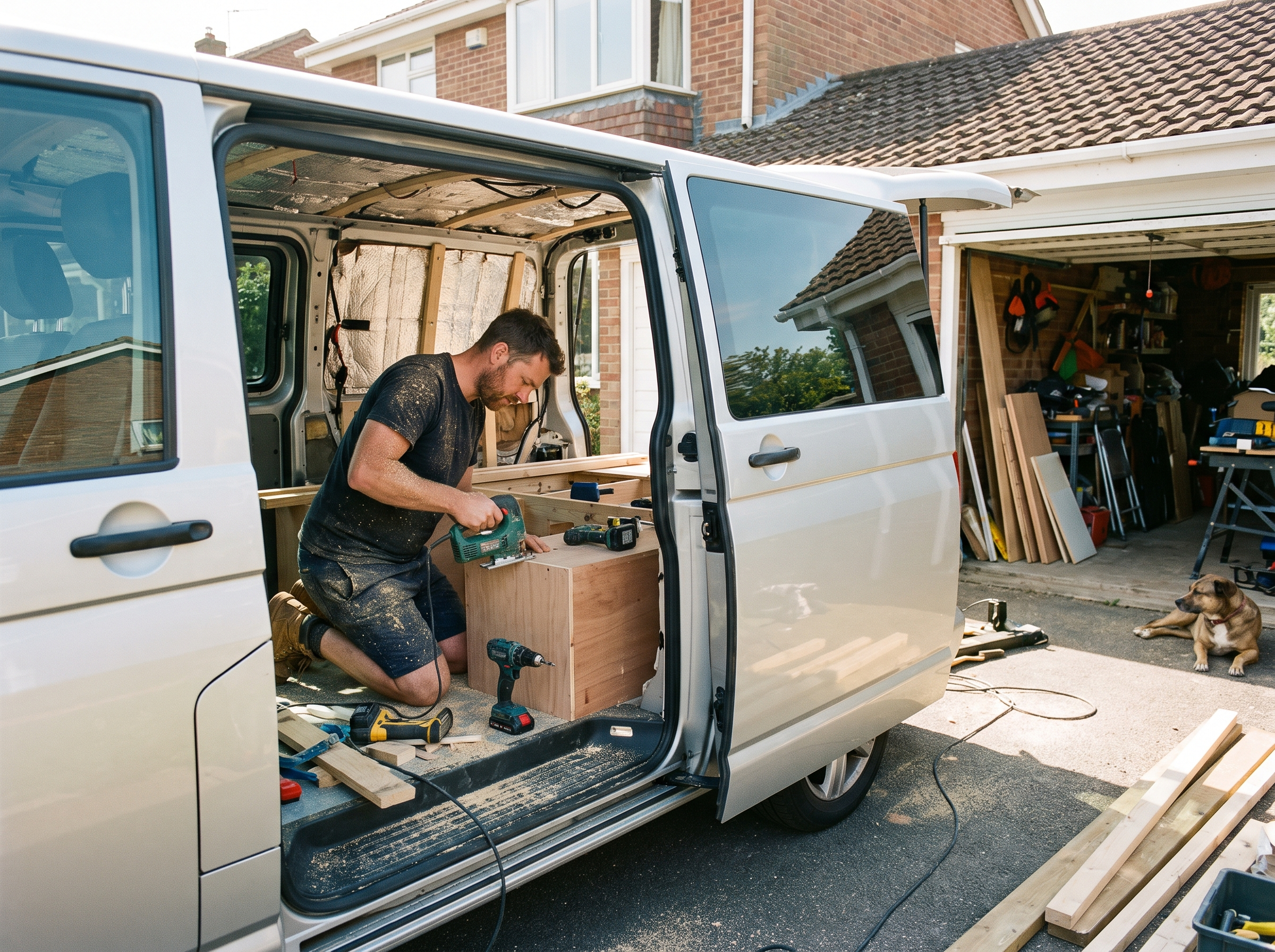
Self build campervan finance is one of the most common questions we hear from people part way through a conversion project. You have found the van, you have a plan for the layout, and then you reach the point where the numbers need funding. That is usually where the uncertainty starts.
The short answer is that finance is often possible for a self build campervan, but it is rarely as simple as walking into a high street lender and asking. Converted vans sit outside standard lending criteria, and automated systems tend to struggle with anything that does not fit a neat box.
This guide explains why that happens, what your options usually look like, and what you can do to put yourself in a stronger position before you apply.
Why self build campervans sit outside standard lending criteria
Most vehicle finance is built around factory built vehicles or professionally converted vehicles. A lender can look up the make, model and specification, see a recognised valuation, and understand exactly what they are securing the agreement against.
A self build breaks that model. The van left the factory as a panel van, and everything that makes it a campervan was added afterwards by you or by a converter. There is no manufacturer specification for a bespoke layout, and the value sits partly in workmanship that no valuation guide records.
Lenders are not being awkward. They simply need to understand what they are funding. The difficulty is that many mainstream applications are assessed automatically, so an unusual vehicle can be declined before a human ever looks at it.
This is exactly the situation where a specialist broker earns their place. Talking to a lender who understands the conversion market, and presenting your project properly, often changes the outcome.
The two things you might be financing
It helps to be clear about what you are actually asking to fund, because the two scenarios are treated quite differently.
Financing a van that has already been converted
If the conversion is complete, whether you built it yourself or you are buying somebody else’s finished self build, you are financing a vehicle. The lender assesses the van as it stands today, taking into account its age, mileage, condition and the quality of the conversion work.
Buying a finished self build from a private seller adds another layer, because the lender will want to confirm the seller is the legal owner and that there is no outstanding finance on the vehicle. That is a normal part of the process rather than an obstacle.
Financing the conversion work itself
This is the option many people do not realise exists. Rather than funding a finished campervan, it may be possible to arrange finance that covers the cost of converting a van you already own, or the combined cost of buying a base van and converting it.
This suits people who have found the right base vehicle but need to spread the cost of the build over time instead of paying for it in one go. Availability depends on the lender, the vehicle and your circumstances, so it is worth discussing early rather than assuming it is not possible.
What lenders tend to look at
Every application is assessed individually, but a few themes come up consistently with self build campervan finance.
- The base vehicle. Age, mileage, service history and condition all matter. A well maintained van with a clear history is easier to place than a high mileage vehicle with gaps in its record.
- The quality of the conversion. Work carried out to a good standard, with proper fixings, safe electrics and gas installed by a qualified engineer, gives a lender far more confidence than an unfinished or improvised build.
- Evidence of what has been spent. Receipts and invoices for materials, appliances and any professional work help demonstrate the value in the vehicle.
- Your circumstances. Affordability and credit history are assessed as they would be for any finance application.
- Whether the build is finished. A part completed conversion is a different proposition to a finished, usable campervan, and the options available may differ accordingly.
Finance is always subject to status and affordability, and no broker or lender can promise an outcome before an application is assessed.
The paperwork that makes a difference
Presentation matters more than people expect. A conversion that looks vague on paper is harder to fund than an identical vehicle documented properly.
Before you apply, try to gather the V5C registration document, the MOT and service history, receipts and invoices covering the conversion, and certification for any gas or electrical work carried out by a qualified installer.
Clear, well lit photographs of the finished interior and exterior are genuinely useful too. They show a lender that the vehicle is a proper campervan rather than a van with a mattress in the back.
If a professional converter carried out any of the work, keep their paperwork. Documented professional involvement usually strengthens an application.
Where DVLA reclassification fits in
Many self builders ask whether they need the DVLA to change their V5C body type from panel van to motor caravan before applying for finance. It is a fair question, and the honest answer is that the two are separate issues.
Reclassification has become considerably harder since the DVLA tightened its approach in 2019. Applications are made using the Motor Caravan Conversion Checklist, form V1006, and the vehicle must meet conditions covering its existing recorded body type, permanent external features and fixed internal living features. DVLA guidance states that the body type will not be changed unless the exterior of the vehicle actually appears to be that of a motor home, which is where a lot of otherwise excellent conversions come unstuck.
Reclassification is not usually a requirement for arranging finance. It can, however, affect other things that matter to you as an owner. Specialist campervan insurance policies often require the V5C to show motor caravan as the body type, and some campsites and ferry operators apply different rates depending on vehicle classification.
The sensible approach is to treat reclassification as a separate task on your list rather than something blocking your finance application. Current guidance is published on the GOV.UK website and is worth checking before you apply, as the criteria are detailed.
Insurance and valuation, briefly
Two practical points are worth planning for early. The first is insurance. Standard van policies rarely cover the contents and fitted equipment in a conversion, so specialist cover is usually needed once the build is complete.
The second is valuation. Owners often invest more in a conversion than the finished vehicle would fetch on the open market, particularly on higher mileage base vans. That gap is worth understanding before you commit, because it affects both what you can borrow and what the vehicle is worth if you later come to sell.
Practical steps before you apply
- Decide whether you are financing a finished vehicle, a conversion project, or both together.
- Gather your V5C, MOT, service history and conversion receipts in one place.
- Get gas and electrical work signed off by a qualified engineer if you have not already.
- Take a full set of photographs of the finished conversion, inside and out.
- Work out a realistic budget, including insurance, and what monthly figure sits comfortably alongside your other commitments.
- Speak to a specialist before applying anywhere, so your application goes to lenders who understand converted vehicles.
How Pegasus Finance can help
Pegasus Finance is a specialist leisure vehicle finance broker, not a lender. That matters with a self build, because it means we can take the time to understand your project and explain it properly to lenders who work in this market rather than pushing it through an automated system.
Your dedicated personal advisor will listen to your exact circumstances, look at whether you are funding a finished conversion or the build itself, and talk you through the options available to you. The service is free to use and there is no obligation to proceed.
Campervan finance page
The Complete Guide to Campervan Finance
The bottom line
A self build conversion does not put campervan finance out of reach. It simply means the usual route may not be the right one, and that how you present the vehicle makes a real difference to the options available.
Get your paperwork in order, be realistic about the numbers, and talk to someone who understands converted vehicles before you apply. Then you can get back to the part you actually care about, which is finishing the build and getting out on the road.
If you would like to talk through your conversion project, our team is happy to help. Finance is subject to status and affordability. Terms and conditions apply.